|
MapGuide API Reference
|
|
MapGuide API Reference
|
An MgMultiCurveString is a one-dimensional aggregate geometry whose elements are MgCurveString geometries. More...
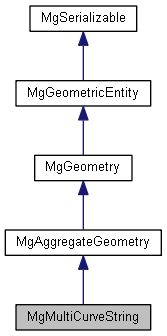
 Inheritance diagram for MgMultiCurveString:
Public Member Functions | |
| virtual MgGeometricEntity * | Copy () |
| virtual INT32 | GetCount () |
| virtual MgCurveString * | GetCurveString (INT32 index) |
| virtual INT32 | GetDimension () |
| virtual INT32 | GetGeometryType () |
| virtual bool | IsClosed () |
| virtual bool | IsEmpty () |
| virtual MgGeometricEntity * | Transform (MgTransform *transform) |
| Returns a transformed copy of this geometric entity. | |
An MgMultiCurveString is a one-dimensional aggregate geometry whose elements are MgCurveString geometries.
 // A helper class additional to those created in the
 // MgCurveString example code is needed.
 $curveStringCollection = new MgCurveStringCollection();

 // After each MgCurveString geometry is constructed,
 // it is added to an MgCurveStringCollection.
 $index = $curveStringCollection->Add($curveString);
 echo "A curve string is added to a curve string collection at index: $index\n";

 // construct the MgMultiCurveString geometry
 $multiCurveString = $geometryFactory->CreateMultiCurveString($curveStringCollection);

 // print out the Agf Text string for the geometry
 $multiCurveStringAgfText = $wktReaderWriter->Write($multiCurveString);
 echo "AGF Text representation of MultiCurveString: $multiCurveStringAgfText\n";
 using OSGeo.MapGuide;

 private MgWktReaderWriter wktReaderWriter;
 private MgMultiCurveString mcsCsAs001120Ls203132CsAs001120Ls203132;
 // the following arrays are used for segments of a curve string
 // the first coordinate in each array is actually a flag
 // 0 indicates an arc segment and 1 indicates a linear segment
 private double[,] as001120 = { { 0, 0 }, { 0, 0 }, { 1, 1 }, { 2, 0 } };
 private double[,] ls203132 = { { 1, 1 }, { 2, 0 }, { 3, 1 }, { 3, 2 } };
 private double[][,] csAs001120Ls203132Data;
 // the data for 2 curvestrings
 private double[][][,] mcsCsAs001120Ls203132CsAs001120Ls203132Data;
 private String geometryAgfText;

 public MgMultiCurveString CreateAMultiCurveStringXY(double[][][,] curveStrings)
 {
     MgCurveStringCollection curves = new MgCurveStringCollection();
     for (int i = 0; i < curveStrings.GetLength(0); i++)
     {
         curves.Add(CreateACurveStringXY(curveStrings[i]));
     }
     return geometryFactory.CreateMultiCurveString(curves);
 }

 csAs001120Ls203132Data = new double[2][,];
 csAs001120Ls203132Data[0] = as001120;
 csAs001120Ls203132Data[1] = ls203132;
 mcsCsAs001120Ls203132CsAs001120Ls203132Data = new double[2][][,];
 mcsCsAs001120Ls203132CsAs001120Ls203132Data[0] = csAs001120Ls203132Data;
 mcsCsAs001120Ls203132CsAs001120Ls203132Data[1] = csAs001120Ls203132Data;
 mcsCsAs001120Ls203132CsAs001120Ls203132 =
     CreateAMultiCurveStringXY(mcsCsAs001120Ls203132CsAs001120Ls203132Data);

 // print out the Agf Text string for the geometry
 wktReaderWriter = new MgWktReaderWriter();
 geometryAgfText = wktReaderWriter.Write(mcsCsAs001120Ls203132CsAs001120Ls203132);
 // geometryAgfText now contains the AGF representation of the multi-curve string
 1.8.0
1.8.0